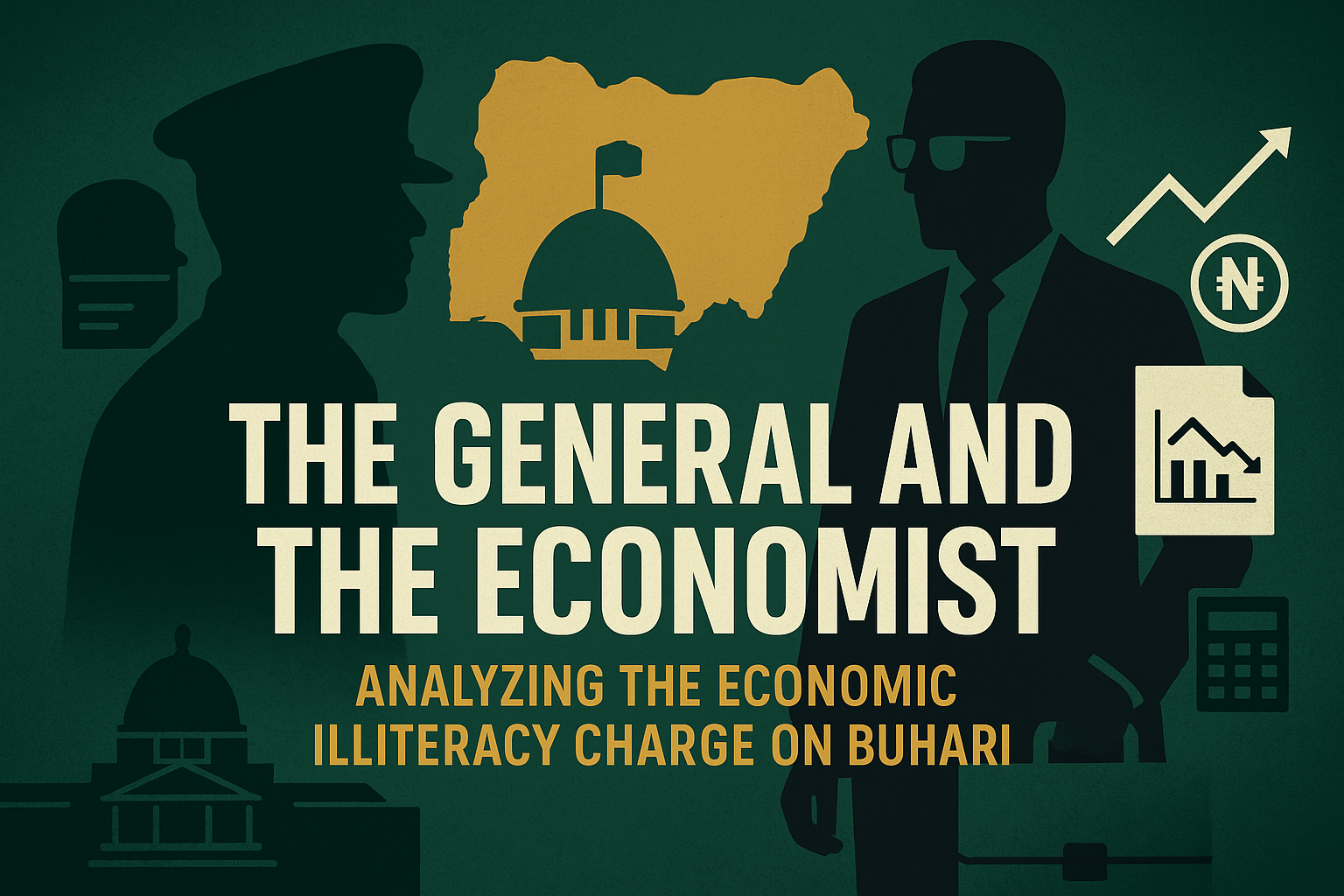
The statement, “The Buhari I know is economic illiterate,” is a stinging, highly publicized critique leveled by the late Second Republic politician and public commentator, Dr. Junaid Mohammed. This was not a casual political jab; it was a deeply personal and professional assessment from a former staunch supporter who became one of President Muhammadu Buhari’s harshest and most consistent critics.
The search intent behind this keyword is clear: Analytical Scrutiny of Buhari’s economic record through the lens of one of his most powerful detractors.
We need to look beyond the inflammatory label of “illiterate” and understand the specific, documented policy failures that Dr. Mohammed was referencing. His critique targeted not just the President’s personal knowledge, but the entire economic philosophy of the administration, which he argued was leading Nigeria to disaster.
Junaid Mohammed: The Critic From Within
To understand the weight of the “economic illiterate” charge, you must first understand Dr. Junaid Mohammed’s position. He was a Northern intellectual and former lawmaker who had previously supported Buhari. His critique was particularly devastating because it came from a source expected to be loyal.
Mohammed’s argument was never just about Buhari’s military background; it was a fundamental disagreement with the approach to governance. He argued that the administration was characterized by:
-
Nepotism and Cronyism: Mohammed believed that Buhari prioritized loyalty and personal relationships over competence, appointing individuals with zero or shallow economic knowledge to key financial positions.
-
Lack of Intellectual Curiosity: He claimed the President relied too much on a narrow inner circle and refused to read or engage with modern economic ideas, leading to policy inertia.
-
Ideological Rigidity: Buhari, having been Head of State in 1984, brought a rigid, authoritarian, and control-driven mindset to a 21st-century economy that required flexibility and market responsiveness.
The Three Policy Failures Driving the “Illiteracy” Charge
Dr. Mohammed consistently pointed to three major areas where the administration’s handling of the economy, in his view, proved its lack of sophisticated understanding.
A. The Currency and Foreign Exchange Policy
This was perhaps the most direct evidence Mohammed cited when claiming “economic illiteracy.” For much of Buhari’s first term, the administration pursued a rigid, fixed exchange rate policy despite plummeting oil revenues.
-
The Flaw: By trying to artificially defend the Naira against the dollar, the government created a system of multiple exchange rates. This immediately led to:
-
Arbitrage and Corruption: Those with political access bought dollars cheaply from the Central Bank (CBN) and sold them at a massive premium on the black market, leading to instant, illicit wealth transfer.
-
Forex Scarcity: Businesses struggled to access the foreign exchange needed to import raw materials and spare parts, leading to massive production cuts, factory closures, and rising unemployment.
-
Mohammed argued that only someone who fundamentally failed to grasp the dynamics of currency movements and open markets could pursue a policy so detrimental to manufacturing and trade.
B. The Anti-Market Stance and Interventionism
The Buhari administration was often seen as ideologically skeptical of free markets. This manifested in policies that favored state control and intervention over private sector dynamism.
-
The Border Closure: While intended to boost local rice production, the unilateral closure of Nigeria’s land borders was criticized by economists for punishing legitimate businesses, fueling inflation (by restricting food imports), and violating regional trade protocols, all without achieving the desired security or economic diversification goals.
-
The Subsidy Conundrum: The refusal to immediately remove the fuel subsidy, a massive drain on the treasury, was seen by critics like Mohammed as a financially irresponsible policy driven by political populism rather than sound economic calculation. He saw the continuous funding of this deficit as an act of fiscal recklessness.
C. The Debt-Funded Infrastructure Model
Mohammed, along with others, questioned the long-term viability of the administration’s infrastructure drive, particularly its heavy reliance on foreign debt.
-
Unsustainable Borrowing: While infrastructure (like rail and roads) is necessary, the borrowing rates and the subsequent ballooning of the national debt were deemed unsustainable, particularly as debt servicing began consuming an ever-larger portion of the national revenue.
-
The Neglect of Social Capital: Mohammed argued that the focus on large, visible infrastructure projects ignored the dire state of human capital (health and education). He believed that true diversification required massive investment in those sectors, which he felt an “economically illiterate” government naturally ignored in favor of easier, debt-funded grand projects.
The Lasting Verdict: Leadership and Economic Knowledge
Junaid Mohammed’s highly provocative statement does more than just attack a politician; it forces us to confront a recurring problem in developing nations: Can a leader with limited technical knowledge steer a complex, modern economy?
The legacy of the “economic illiterate” label is the understanding that, in a volatile economy like Nigeria’s:
-
Leadership is not enough: Integrity (Buhari’s supposed reputation) is insufficient without accompanying economic competence.
-
A “Strong Man” approach is often weak economics: Rigidity and an unwillingness to listen to a broad spectrum of expert advice (like the IMF/World Bank advice that Mohammed criticized Buhari for ignoring) can be more dangerous than deliberate corruption.
The economic woes that led to two recessions under Buhari’s watch, coupled with soaring inflation and joblessness, provided the harsh empirical data that gave Dr. Junaid Mohammed’s scathing critique its lasting resonance. The ultimate judgment, of course, lies with the impact on the common man, whose purchasing power was severely eroded during this period.